Hi, I'm Mikhail Ilin. I'm a random stuff engineer, indie maker and
solopreneur. Most of the things I like are related to web technologies, music
or design. I've founded Lopaka.app.
My GitHub, Twitter and
LinkedIn
-
Email Archiving: The Inbox Zero Secret Most People Ignore
General ·Email archiving is a seriously underrated feature. And I know most people don’t use it.
It’s helpful to think of your inbox as a to-do list: everything in there needs your attention. Anything you’ve already read and don’t need to act on? Just archive it. It doesn’t disappear or get deleted — it simply moves to your email archive. And every now and then, your inbox becomes empty. That feeling is chef’s kiss.
If you’ve got tens of thousands of emails sitting in your inbox, you can always start fresh and archive everything at once.
Once your inbox is clean, you suddenly notice how much junk you’re subscribed to. Time to hit unsubscribe on all of it.
-
Pomodoro timer for Flipper Zero!
General ·Flipper Zero is a portable Tamagotchi-like multi-functional device. I follow this project since the idea appeared in Pavel’s mind. We had a good time working together on it’s web presence at the very early stage. As soon as they announced the user apps feature I started to develop ideas of such applications. This app is made to make it easier to follow the Pomodoro time management method.
Flipper Zero developer experience
This is my first try to do something bigger than “Hello world” with C language. Most of the code is a copy-paste from random pieces of the flipper firmware. I took the bluetooth keybord as a base because it had a similar structure and UI. I had no idea of typing and variables syntax. Everything was made by trial and errors method.
I can describe the current Flipper Zero developer experience as very convenient: the dev kit is awesome, the qFlipper app is very fast and useful.
There are some minor exceptions happen here and there but the main workflow is perfectly smooth.
Pomodoro App for Flipper Zero
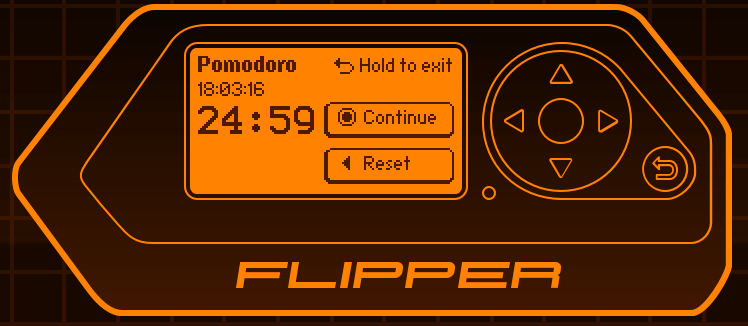
Here we have three timers:
- Classic one 25/5 minutes
- Twice longer 50/10 minutes
- Superfast 10/2
Other features:
- Regular system clocks display
- Tomato counter which shows how many working cycles you’ve finished (up to 5 tomatoes)
- Rest timer
The device API is being changed every day so feel free to ask me for an update.
-
The most underestimated gaming platform?
General ·I believe nobody knows how astonishing browser games can be and how many advantages it has. Engineers at Evolution are focused on creating the most accessible and immersive experience for our players using Web technologies! Today I will show you why I think it is underestimated and what cool things you can do in browser.
DOOM
But let me first share something more personal. My first experience with 3D video games happened when I was 8 years old. I was lucky to be invited to use my father’s workplace to play DOOM for the fist time in my life. This cover art exactly describes what I felt sitting in front of CRT display with Sound Blaster and stereo speakers maxed out.
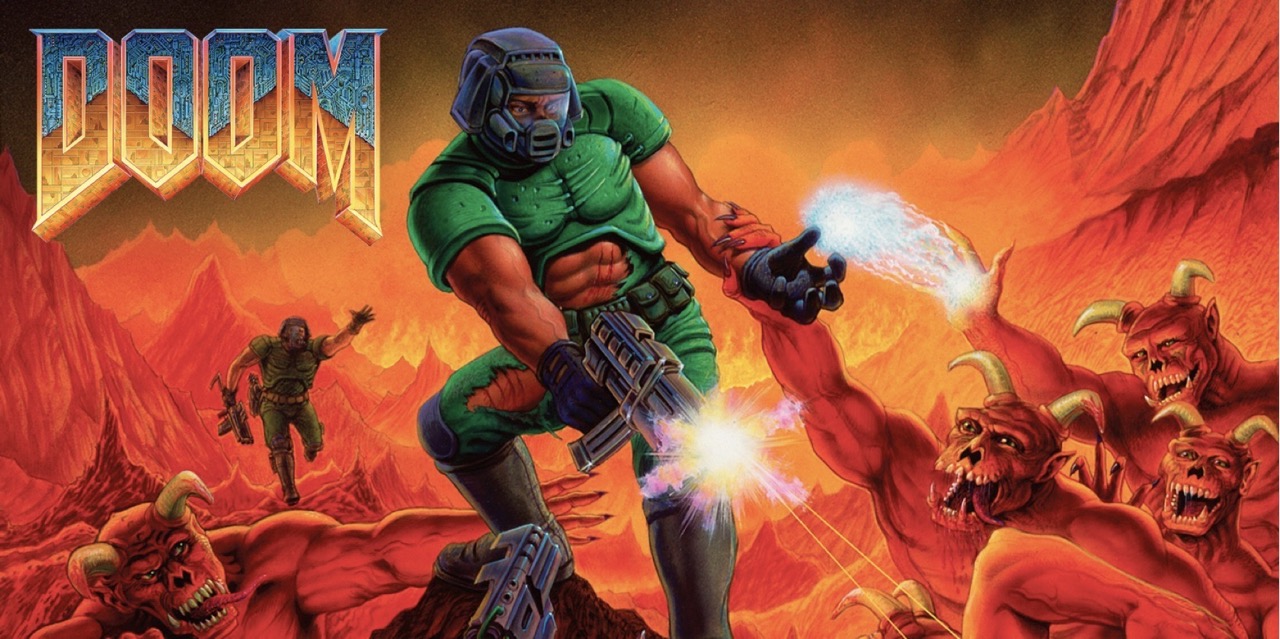
I will never forget this feeling. Yes, I was really scared! I have never experienced anything like that before. Of Course now it looks very simple. But at that time… That was insane!
VR
My second overwhelming experience happened to me almost 20 years later When the first oculus VR headset was released. Actually it was the early adopters developer kit: it had a lot of gear needed to be set up, the screen resolution was very low, there were no any controllers and it had only three degrees of freedom. But there were already plenty of games and demos which bring me the idea that the future is here. You could literally fly on a dragon, ride the roller coaster and it felt absolutely real.
You may be surprised if I tell you that the next time I was astounded was when I joined Evolution two years ago. At that time I already had many years of web development experience behind. I worked with ReactJS, I knew about video streaming services, and had some experiments with 3D graphics.
But I couldn’t imagine how far people can go in their passion for engineering stuff and how powerful modern browsers are.
Onboarding
In Evolution we have a tradition that every new engineer has to pass a two weeks onboarding.
The interesting part of this process is that you must play all these games we have.
Literally: we reserve several days only for playing games. I believe this is a great way to impress and motivate newcomers.
Here is what I learned during that time.
Live Casino
Let’s take a look at this variation of classic casino game — Lightning Roulette.
I was like: what is this thing? Is that a TV show? A video game? A Twitch stream? What’s happening there?
It’s a bit complicated…
There is a live video stream from one of our studios. We can see this nice game presenter, a roulette wheel, a big screen and many other physical props. On top of this video there is a beautiful UI.
It has a betting grid the same as you could see on a real roulette table, the common UI like settings, balance, help section and other stuff — there is a chat feature!
Let’s think about what is happening there:
- Players place bets with web app
- Which sends all data to server
- There is a video stream from studio with several cameras on different angles
- The game presenter interacts with players through Dealer UI which is hidden behind the camera
- the screen on the back shows the multipliers generated in real time with Unreal Engine
- The ball is being automatically pushed to the wheel which is always spinning
- When the ball stops in the pocket it is being scanned and sent to server
- The player UI is updated with the results
- The game presenter congratulates winners!
BOOM!
And it works perfectly on every mobile device. Amazing?
This is just a ReactJS application with some canvas animations. With a lot of mechanical and electrical engineering behind the scenes.
First Person Experience
What can we do to provide a more immersive experience? Make a video game!
So we made a 3D version of the Lightning Roulette!
We call such games the First Person. Maybe to pay a tribute to the first person shooters like DOOM :)
Now it’s a 3D scene with a Roulette table. You can place bets like in real life by placing chips on the table or dragging it around. The ball is spinning and falling exactly on a specific pocket. The outcome is generated randomly on the server side.
I was impressed by the amount of details here: the shadows, the materials, textures, the reflections on the floor, and how smooth the animations are.
And we are still in the web browser! And it still works perfectly on any mobile device! Made with React, WebGL and BabylonJS library.
Lightning
You may have noticed that lightning strike animation.
One of the first implementations was made using animated sprite image. Yes, the good old sprite animation from 90s which you can see in DOOM.
Game artists were generating all these frames and sent us a quite big PNG image. Unfortunately such images are too big to use on the web — it really affected the loading time.
We definitely needed something different. So we start thinking: what lightning is?
A sequence of branches one coming from another. A tree! A very sophisticated randomized tree algorithm.
We can draw a stem as a simple line in 3D space, then find some points in between and change the direction and add more and more lines.
After several attempts we’ve got a pretty customisable lightning strike generator.
- This costs just a few kilobytes of code.
- No need to ask game artists for images.
- It can be any shape or size and any color you like!
- The magic of software engineering.
Shaders
Speaking about magic: one thing caught my attention because I couldn’t explain how it is made.
These smoky clouds and flying stars — what is that? Maybe you can tell? Animated GIF? A video recording? Canvas or CSS animation?
It is a shader! And shaders appear to be a part of WebGL specification!
A little side note if you are confused as I was:
“Shader is a computer program that calculates the appropriate levels of light, darkness, and color during the rendering of a 3D scene”
Long story short: it is a procedural graphics generation language called GLSL which is widely used in 3D graphics. It renders purely on the GPU and is really efficient.
And all these beautiful effects are just ONE kilobyte of code!
Actually in theory it is possible to generate any object or the scene using shaders.
It will just take a lot of time :) But you won’t need any models or textures for that. Only pure GLSL code.
This is an example of animated shader:
And this is the code. The magical mystery 500 characters:
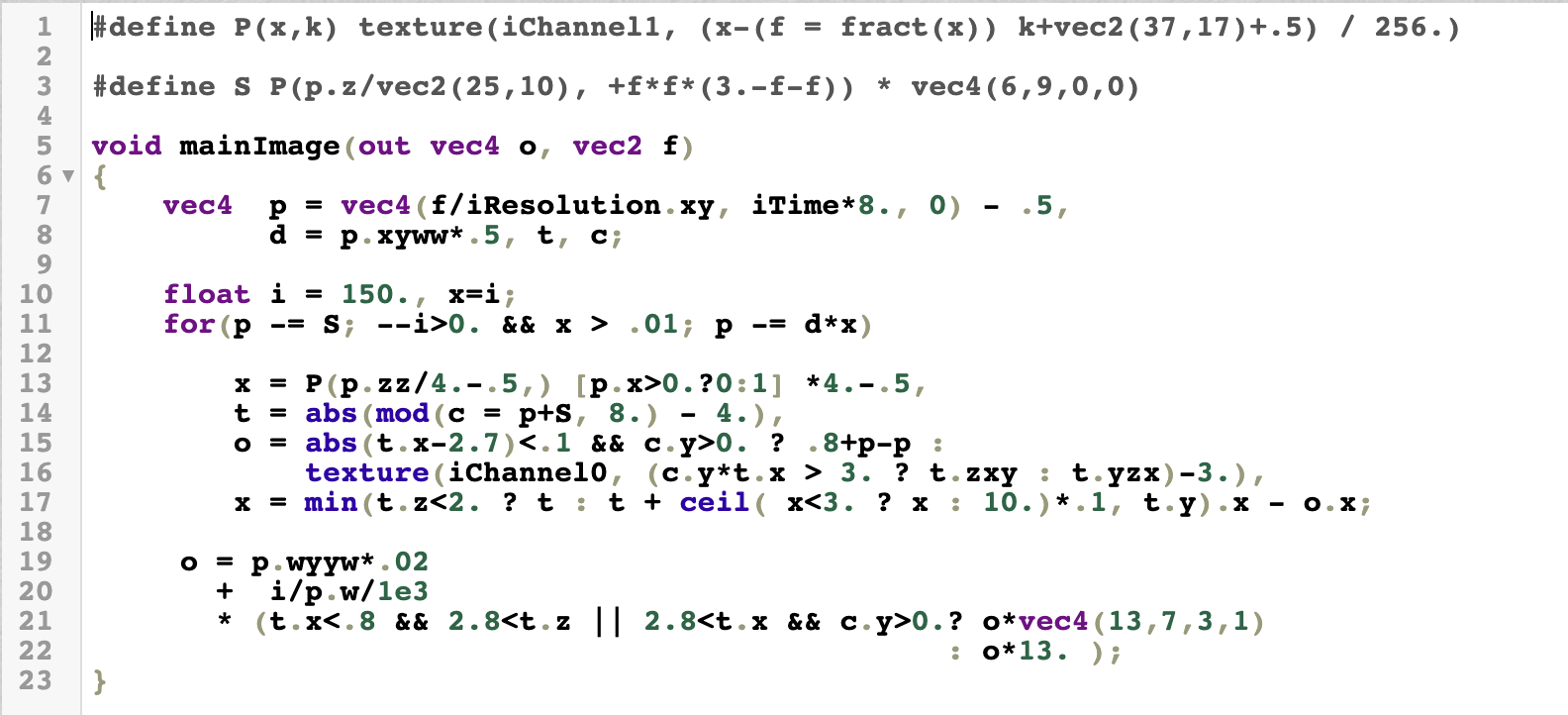
Don’t ask what’s happening here — all I can tell is there are a lot of mathematical operations. Watch yourself.
I recommend you to check out the shaders of the week. They are insane. People even generate SOUND with shaders and pass it to Web Audio API. But it’s more like a proof of concept than practical advice.
People usually think shaders are reserved for “real” games but it works on the Web through WebGL.
Physics
Let’s check out another game. There is one thing I want to show.
Craps is a dice game in which players bet on the outcomes of the roll of a pair of dice.
(This is all a 3D scene by the way)
For starting the game we could make just a simple button, like a “spin” one from the previous case.
But! Beside that our engineers implemented a physics simulation of throwing the dice! Like angry birds, but in 3D.
This is a BabylonJS feature, but it relies on one of many physics simulation libraries. There are many ways to use it — for example here you can see explosion animation followed by hurricane effect.
In our case the outcome is still randomly generated by the server, but the collision animation made me feel it’s real.
Magic curtain
The next one was really surprising for me.
On this screen we have a slot machine with barely visible video on the background behind the curtain:
If you gaze long into the curtain, the curtain starts gazing at you :) And you may notice that:
- The coins are rotating, just a little
- The elements always has random order
- It has randomly placed shiny glares
- It is infinite long and responsive
How is it made?
What comes to my mind first is this could be a bunch of animated GIF images. But no, it would be too big and low quality with no alpha-channel and costs extra HTTP requests.
Maybe we can use some PNG images and generate a grid with JavaScript and animate it with CSS…
But it seems to me our engineers would be still unhappy with that: you have to generate thousands of HTML elements and somehow randomize the animation start time otherwise everything would look synchronous and fake and be less performant. You can check my React + CSS implementation on CodeSandbox and see how if affects browser performance.
Luckily we have some smart guys. So they made it with WebGL and shaders!
There is only one tiny image sprite used which is about 10 kilobytes.
We had that slot machine already made by using a small 3D library called OGL so we used it for curtain animation as well.
The lines itself, coins rotations and sparkle animations are made using shaders.
The result is lightweight, customisable, responsive and performant. Made with pure JS! Rendered and animated with GPU!
Mixed reality
Allright! The last stop in our journey is the Gonzo Treasure Hunt live show.
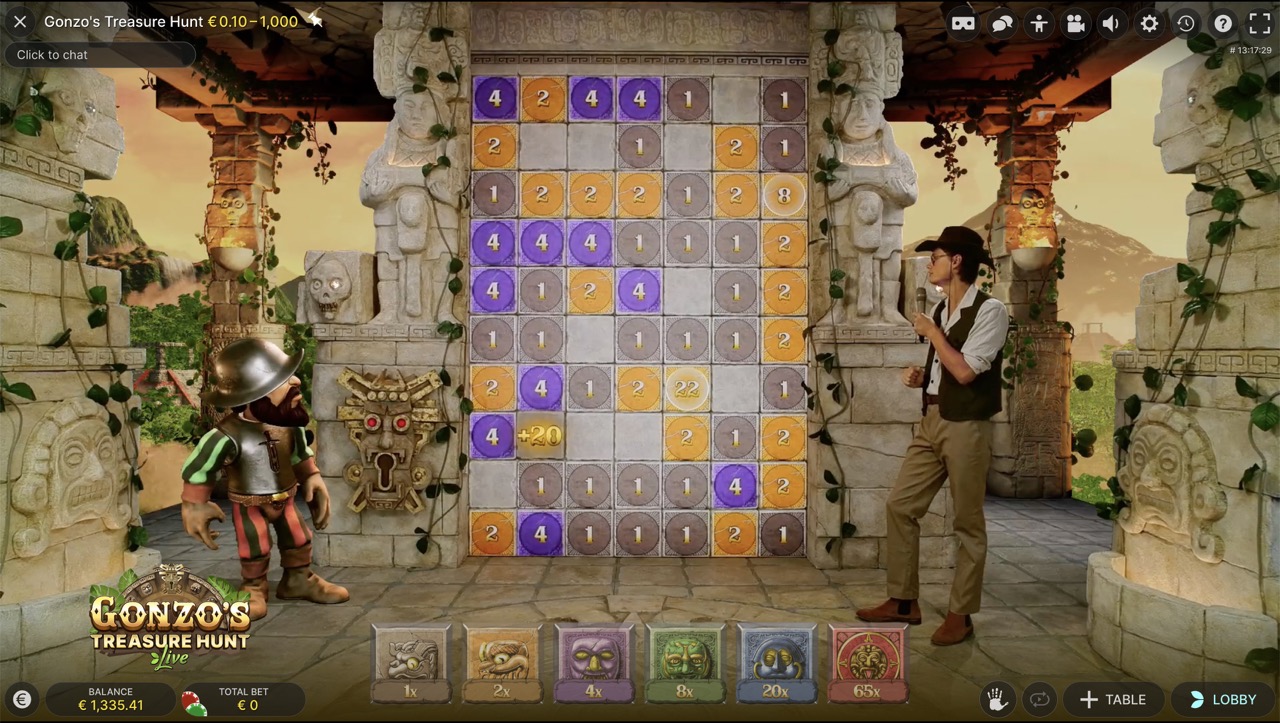
At first glance it seems like nothing special here. We already know most of the components involved.
Just a quick recap:
- This is a video stream from studio
- 3D graphics in background renders with Unreal Engine
- The player UI
- The dealer UI
But there is a tiny button added at the top of the screen. It turns out this game is also playable in VR mode! Look:
This is an absolutely different video stream. And there are two cameras used to make a 3D effect. This character walks around and sometimes interacts with a player.
But we had one problem: in the 3D world there are no HTML elements at all. No React JSX or CSS.
For that reason the whole user interface was recreated with 3D graphics. Buttons, sliders, inputs - all of that are 3D objects.
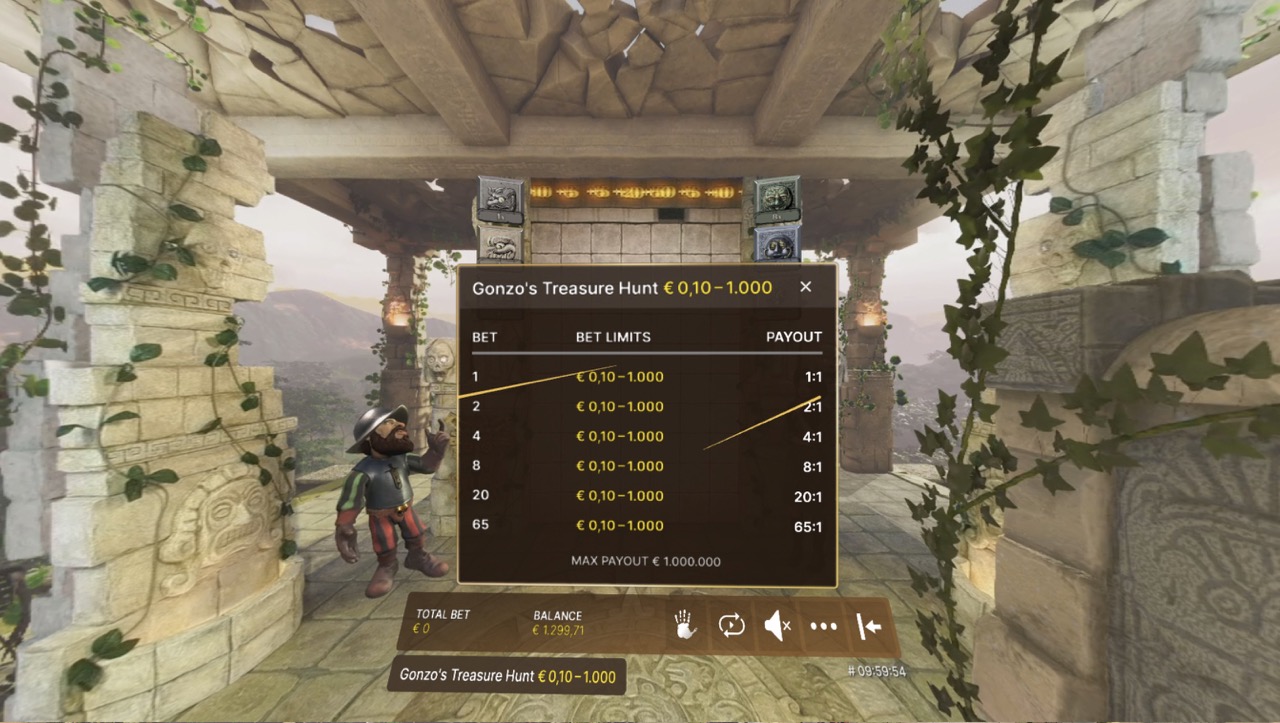
You can rotate your head and use your controllers to press buttons - do everything you would expect in VR.
So what a combo we’ve got: a video stream, unreal engine, web interface, VR and 3D graphics in a web browser.
On any device. Could you imagine that?
Conclusion
For a long time I thought that there is a world of serious game development where people do really cool 3d games for consoles, high-end PCs.
The world of 3D optimisations, GPU shaders computation, shadows and reflections, realistic physics and virtual reality.
But it all appears to be available for any javascript engineer. There are many tools and libraries available now. It is all easy to use and share with others. And players don’t have to install or download any software or buy any specific device to play it.
The future is now!
Trust me! At Evolution we have built world-famous games just using the web browser.
-
Stop shaking hands
General ·Shaking hands is harmful. At least, if you meet more than once a week. In any big male group, there is a ritual of greeting and farewell every morning and evening. It’s a terrible atavism.
Every person who enters the room goes around and shakes hands with all the fellows. A similar ritual is performed at the end of the working day. This happens every day, five days a week.
Everyone who extends their hand shows complete indifference to what is happening. In a large team, everyone treats this formally and without interest.
This distracts us from work. We are forced to be distracted from our thoughts and pay attention to everyone who enters or leaves.
It’s unhygienic. A person came from the street: held onto handrails in transport, ate food, picked their nose. Who knows where their hands have been?
Most people do this automatically because it’s the norm. Because you’re a man, and men shake hands. Because what, you think you’re too good to shake hands?!
We see each other every day. What’s the point of this show? A simple verbal greeting is enough. It’s not even necessary to respond with “Hello!” to everyone. You can always greet personally the person you want to talk to or have close contact with.
Women are lucky in this regard… (if we ignore the inequality caused by shaking hands habits)
-
How to remove Samsung (or any other phone) wallpaper
General ·There is only one way to remove or delete the default wallpaper on your Samsung Galaxy Android phone or any other iPhone: using blank 1 pixel PNG file
Yeah, it’s just a simple 123 bytes image.
Here’s the step by step instructions:
- Create a black 1×1px image manually or just download image
- Save it in your phone gallery
- Open the gallery and find that image
- Tap on «…» or look for some submenu with «Set as wallpaper» title
- Ignore the warning about image size
- Be happy with you beautiful black background with no wallpaper at all
After that you can remove image from gallery. The background will stay black.
