Hi, I'm Mikhail Ilin. I'm a random stuff engineer, indie maker and
solopreneur. Most of the things I like are related to web technologies, music
or design. I've founded Lopaka.app.
My GitHub, Twitter and
LinkedIn
-
Madeira Places Map
General ·I turned my Madeira notes into a small interactive map: hotels, coffee spots, restaurants, beaches, viewpoints, activities, and hikes.
-
PostHog Is an Incredible Product
General ·Guys, I gotta tell you, PostHog is an absolutely incredible product. It’s an analytics platform absolutely packed with features. They’ve got hundreds of thousands of users.
And the development process there is super clean and transparent. The documentation is so convenient and detailed, the processes are so clear, everything is adapted for AI agents. Haven’t seen anything like it since GitLab.
I’ve been using Paddle for payments recently and needed analytics reports for payout amounts. So I just went into the PostHog repo, found the similar Stripe data source, and built the same thing for Paddle.
Threw together the code in a couple hours, tested it locally, opened a pull request, and they merged it. That simple.
From the moment they approved the merge request to when I had my feature in production took one hour!
(Okay fine, I spent a month trying to pass all their CI checks, validators, and tests, but it was worth it)
This is a massively popular open-source project that anyone can contribute to and see their feature hit prod an hour after the merge!
Literally every interaction with this product pleasantly surprised me. They’ve got a lot to teach. Had to share these vibes with you.
-
Hermes: The OpenClaw Killer
General ·While I was sitting there, fully immersed in the podcast flow, the winds of change had already swept through the world of AI agents, and I’m here to share the news with you.
The old OpenClaw meta is now like a withered leaf blown away by the wind, while Hermes shines like the morning star.
Thanks Durov for the AI right in the text input field, but I’ll stick to my own words.
Hermes is an OpenClaw alternative with a different architecture. Written in Python. The main thing is that it has self-learning mechanisms baked right into the algorithm. The authors say Hermes grows alongside you.
I’ve been working with it for a week now and moved pretty much everything over from OpenClaw. Everything Glasha used to do now goes through Hermes. Even though it’s still rough around the edges, it works way more predictably.
Plus, while it’s running tasks, you can throw messages at it and they’ll get mixed into the current session on the fly. And if you see it doing something wrong, you can steer it and stop it. That’s a massive advantage.
They recently rolled out profile support, so you can host multiple different agents on one server. Right now on my MacBook I’ve got Hermes running with three agent profiles, each doing different tasks without interfering with each other, but sharing the same environment, same skills, all that common stuff. Though their memory, session history, and the tools they create for themselves stay separate.
And just like that, less than a month later, OpenClaw is already outdated, and a smart, self-learning Hermes awaits us.
-
Building a Trackball for Vibe Coding
General ·I’ve been thinking about making a trackball for vibe coding. Or at least a trackball for myself.
Backstory
I’ve been using a trackball instead of a mouse for ages. It’s basically a mouse, but you roll a ball with your finger instead of sliding the whole thing around.
I also have a walking pad under my desk. I work standing up and turn it on sometimes to get more steps in and keep moving.
With this setup, keeping my hands on the desk isn’t always ideal. I do a ton of dictation and not much typing, so my hand just sits there on the desk getting tired. I wanted more freedom of movement, and I wanted to be able to hold my trackball in my hand while walking. I also thought it would be cool if this controller had a built-in mic and a dictation button.
Couldn’t find anything like that on the market. There are a couple options, but nothing quite matches what I had in mind. Just to be safe, I ordered one from AliExpress that looked pretty close in design. It’ll make a great donor for my project.
So I Decided to Build My Own Trackball
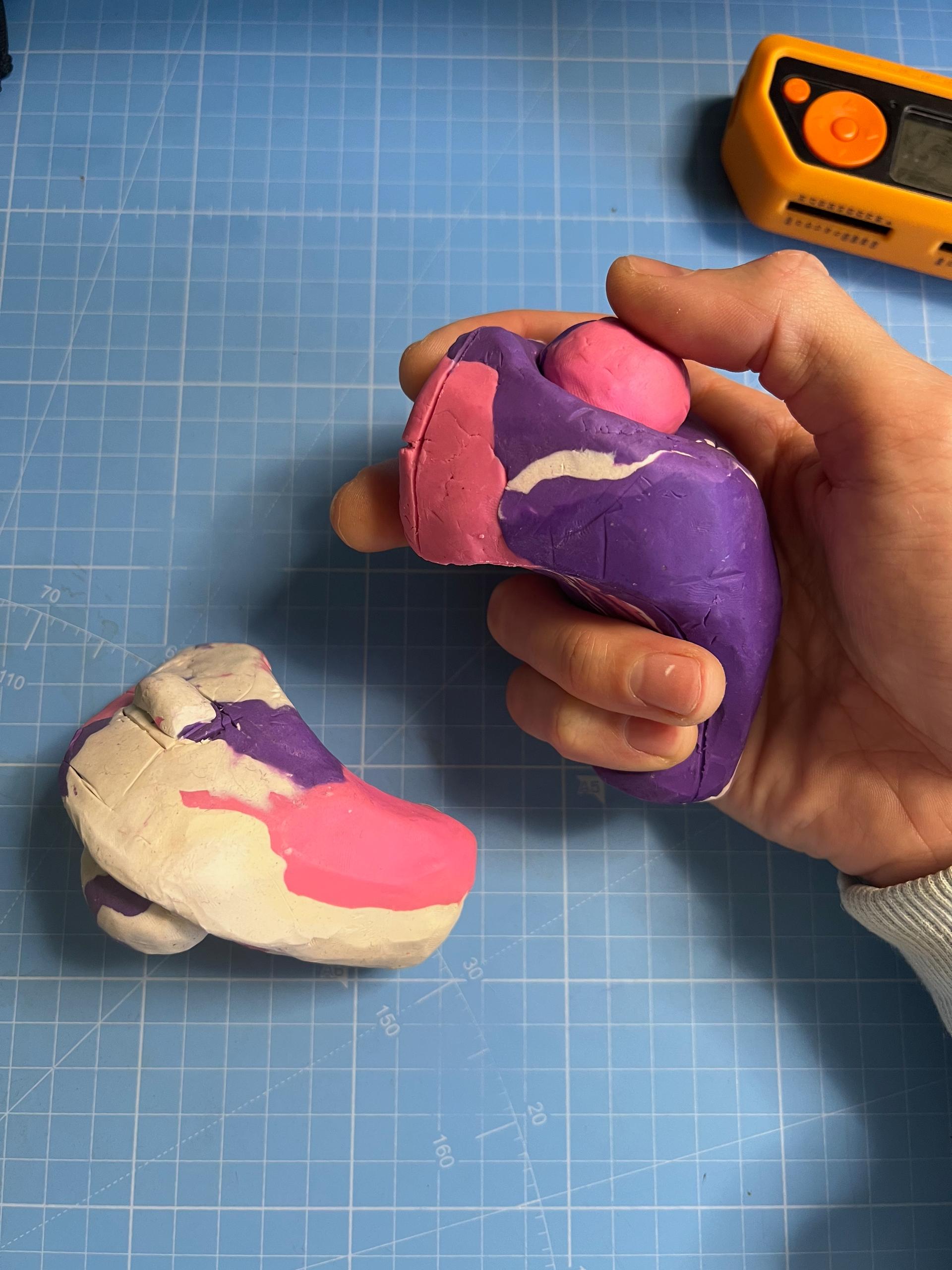
I rode that wave of motivation and started building. First thing I did was go to the store and grab some modeling clay. I sculpted a prototype. Grabbed a whole mountain of the stuff, mashed it into a giant ball. Made the first prototype, then a second, then a third. Then I did a 3D scan with my iPhone. Luma AI is the easiest option.
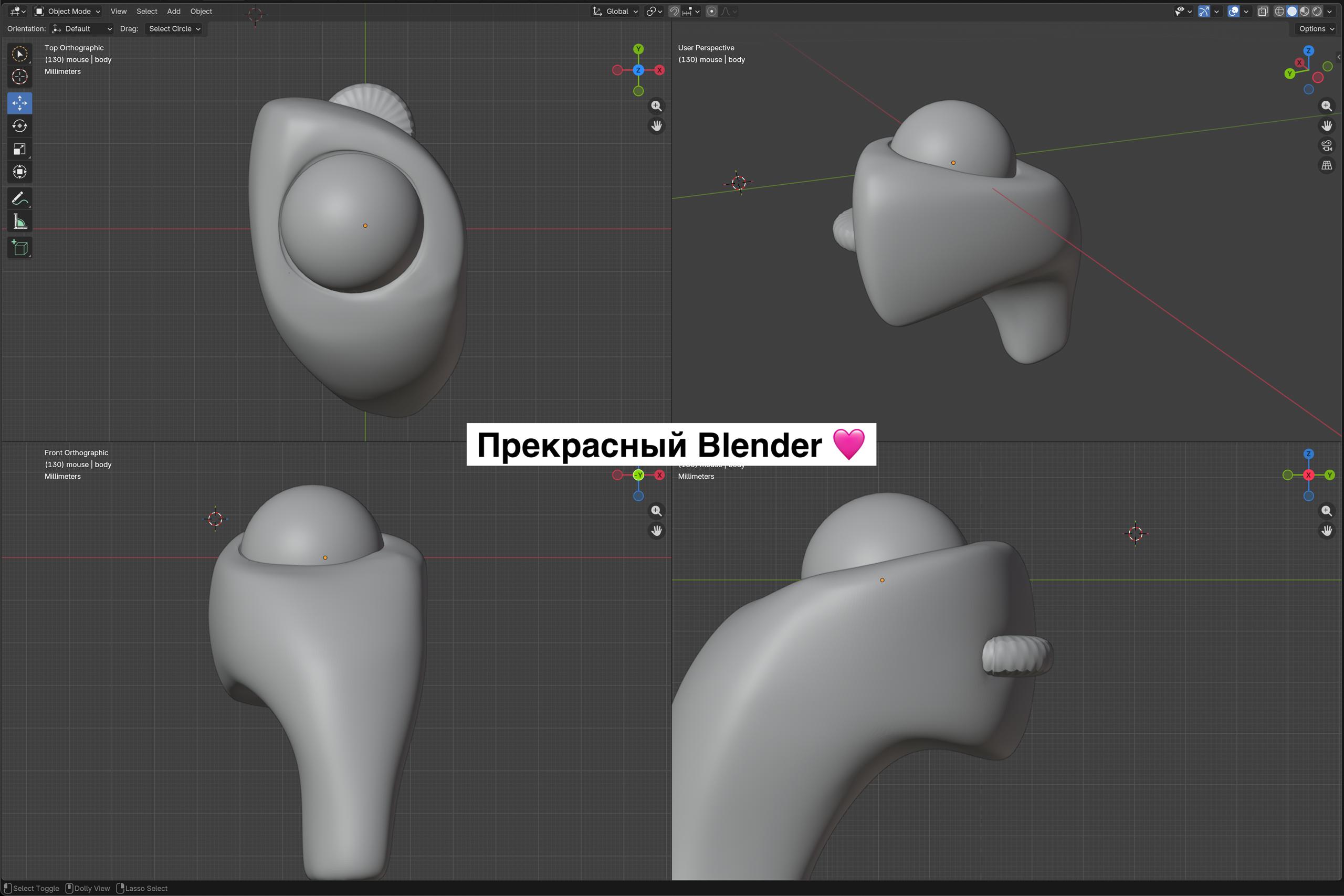
I already knew Blender basics, so I started modeling based on that scan. When the 3D model was almost ready, I started thinking about how I’d actually print it so it would be a proper enclosure.
Blender isn’t great for this kind of work, because if I want to split the enclosure into multiple parts and then add tweaks, details, holes, I’d have to re-split everything from scratch every time. Way too much grunt work for tiny changes.
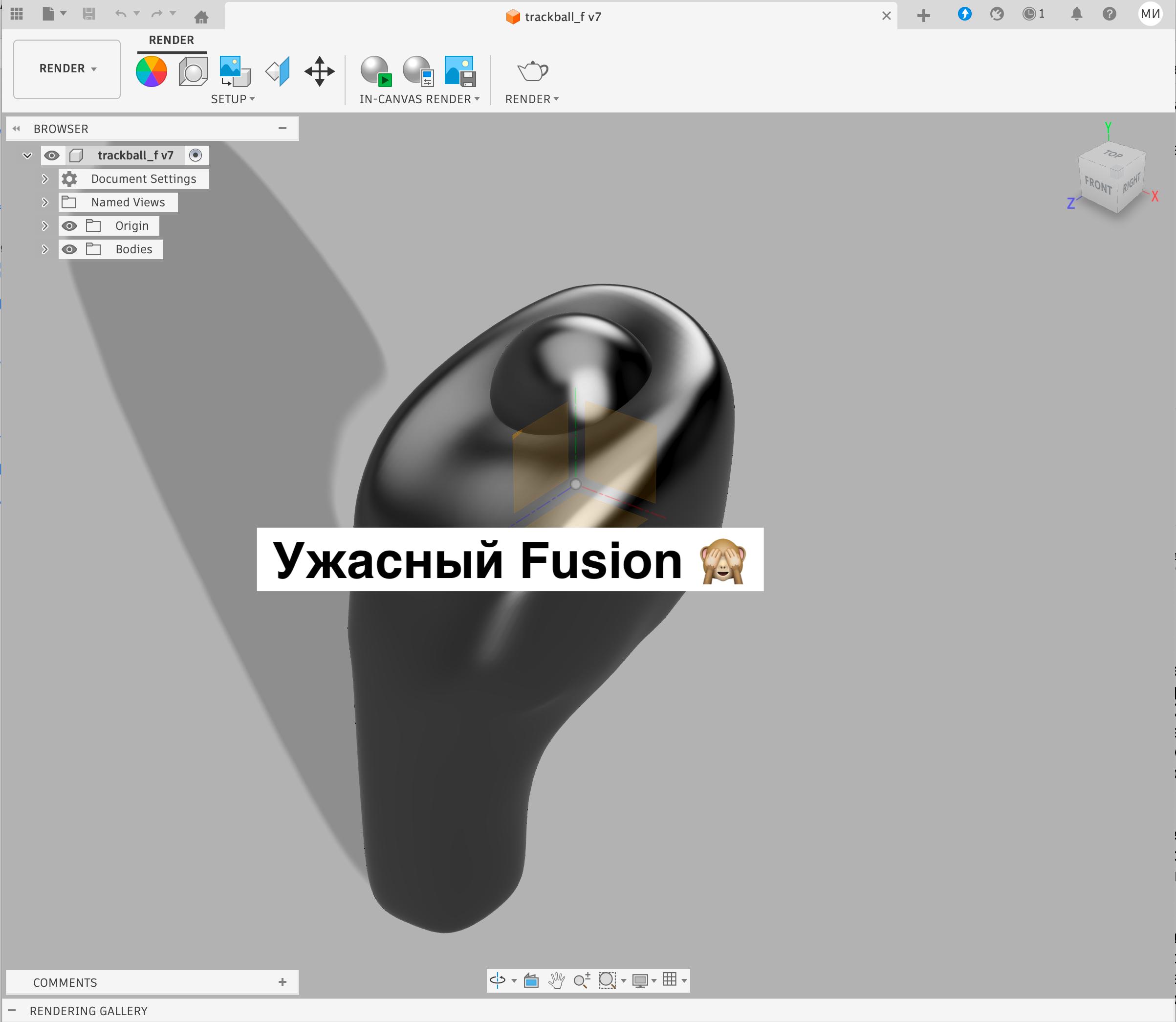
So I installed Autodesk Fusion. It’s pretty much the only, and probably the best free tool for this job. But man, the interface is absolutely terrible, completely unintuitive, maximum confusing. Every single action goes against every pattern you’re used to.
Gritting my teeth, spending a few days, on the second try I managed to model something in there.
The Unexpected Ending
By this point my AliExpress order arrived and I got to try it out in practice… It was a pretty sad day, because that’s the day I realized my whole idea was falling apart due to human physiology.
Pressing a button and controlling the ball with your thumb conflicts with each other, because when you press a button with your index finger, your whole hand tenses up and inevitably your thumb on the ball twitches slightly, and that’s critically important when you’re trying to select and click things on screen with a cursor.
When a mouse sits on a desk, this isn’t a problem because the mouse pushes against the table, and all the force goes into the desk. But when it’s floating in your hand, your thumb and index finger squeeze together. Anyway, that’s where my project ended.
So yeah, that’s how I had a good time. Good thing someone already made a device like this so I didn’t have to spend a ton of time on design, 3D printing, and assembly only to realize in the first five minutes that the idea was doomed from the start. At least I learned some 3D modeling.
Here’s a few pics of the process below.
-
Meet @clawmother_bot — OpenClaw in Two Minutes
General ·I built @clawmother_bot — a Telegram bot where you can create your own OpenClaw assistant in two minutes. I experimented with hosting for a long time, tried different models, and settled on this setup:
Works out of the box You immediately get a dedicated OpenRouter key — that’s a universal provider for accessing any LLM models. And there’s a one-dollar balance for token expenses right away.
By default, it uses the Kimi 2.5 model — powerful enough to start configuring and playing around, yet cheap enough that one dollar lasts a while. I experimented with free models and realized they’re more harm than help.
Payment via Telegram Your token balance is topped up with Stars right through the bot. You can later pick any top-tier model (just ask your claw bot). The main thing is having enough money for token payments. But the most optimal option is an OpenAI Codex subscription, which you’d pay for separately and then configure directly through your OpenClaw agent. Then you won’t have to mess with keys and tokens.
After the trial period ends, you need to subscribe to continue using your agent. I’ve integrated payment via Telegram Stars. That’s the simplest payment method available to everyone.
Reliable hosting I tried various hosting options and ended up setting up my own cluster in Google Cloud. Inside this cluster, isolated containers are created for each client. I need convenient and flexible infrastructure to provide quality service.
So each agent gets its own isolated environment, its own dedicated OpenRouter key, a connected Telegram bot, and 10 GB of disk space. All keys are passed to your container during installation and aren’t stored anywhere in the service. I tried to make the setup process as secure as possible.
Low barrier to entry First week is free. You can just open the bot and in a couple of minutes get your own claw right in Telegram. It’s important to me that everyone can try this technology and decide for themselves whether to continue.
Ready to work I manually built the system image so most necessary packages are included from the start. Otherwise OpenClaw wastes a ton of time installing browsers, connecting skills, configuring APIs, or vibe-coding. I want tokens spent on actual work, not system maintenance.
Killer feature: if you have questions, you can message @clawmother_bot directly and I’ll personally reply and try to help.